1. Surface and edge isolation
Clean, non-abrasive layers separate finished faces from rigid materials. Edge and corner protection addresses the details most exposed during movement and strapping.

Technical resource · International buyers & OEM partners
A finished component is only ready for delivery when its protection and handling plan are ready too. Zenith Porcelain's packaging and handling guide explains the vertical protective system used to prepare fabricated porcelain worktops, panels and laminated components for the next stage of your project.
Review the method before ordering. Share the English booklet with procurement, logistics and receiving teams so the same information travels with the product.
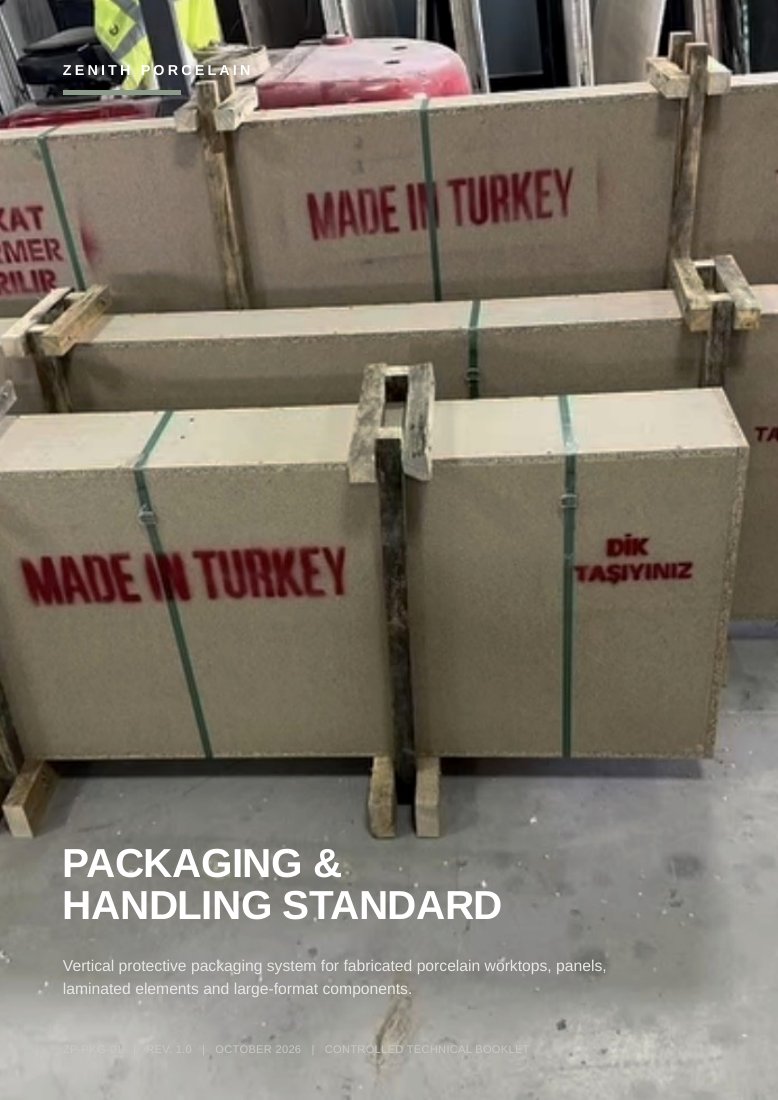
Export resource · Free English PDF
See how finished porcelain components are protected, identified and prepared for controlled handling. Share the booklet with your purchasing, warehouse and installation teams before dispatch.
12 pages · English · PDF · 1.64 MB
ZP-PKG-01 · Revision 1.0 · October 2026
No registration required. Keep a copy available for your delivery team.
Polished faces, mitred returns and sink or hob openings need different protection from an unprocessed slab. For overseas kitchen and bathroom manufacturers, furniture makers, distributors and project teams, the question is not simply whether a component has been wrapped. It is how the protective layers, supports and restraints work together.
The booklet documents Zenith's workshop packaging configuration using production photographs, annotated details and a release checklist. It brings product protection and handling information into the fabrication discussion, rather than leaving them until loading day.
Clean, non-abrasive layers separate finished faces from rigid materials. Edge and corner protection addresses the details most exposed during movement and strapping.
Boards protect the broad faces and distribute local contact. Cut-outs and narrow sections are considered when planning the protective envelope.
Straps hold the protected unit together. Their position and tension must suit the supported component; they are not lifting points or a replacement for a stable frame.
Posts, braces and base supports stabilize the upright pack through protective layers. The method separates product protection from the structure used for handling.
The standard sets out a sequence from product inspection and cleaning to protection, identification, photographic records and quality release. Pack labels connect the protected item to its order, destination and receiving team.
For an international buyer, these records provide a clearer basis for checking a delivery against the agreed component schedule and reviewing any discrepancy.
The booklet covers internal movement, vehicle loading, storage and site unpacking as connected stages. Keeping a pack upright does not, by itself, define a safe lift or a complete vehicle restraint plan.
Receiving teams should know the approved support and lifting arrangement, available unloading equipment and opening sequence before the vehicle arrives. The document explains why a product needs independent stable support before its straps or timber restraints are removed, and why arrival condition should be recorded before unpacking.
Share your component drawings, quantity, destination and intended delivery arrangement with Zenith. Worktops, vanity tops, table tops, fabricated panels, porcelain-glass laminated elements and long narrow components each have their own geometry and vulnerable details.
The booklet deliberately leaves engineering values subject to approval. Maximum pack mass and dimensions, strap specification, timber section, brace spacing and vehicle lashing calculations must be validated for the particular load and transport mode. Destination-specific packaging requirements must also be confirmed for the shipment.
This is Zenith's workshop packaging standard, not an independent certification, a lifting plan or a guarantee against all transit damage. Handling must be carried out by trained personnel using the approved equipment and project-specific instructions.
Bring the fabrication and logistics brief together. Include the delivery country, item schedule, dimensions, material preferences, cut-outs, order quantity and available receiving equipment. Our team can review the packaging scope alongside the production requirements.
Explore our company profile, fabrication capabilities and technical support for professionals.
The 12-page English booklet covers the vertical protective packaging method, workshop photographs, material checks, pack identification, handling controls, storage, site unpacking and the final quality release checklist.
No. Maximum pack mass, dimensions, strap ratings, timber specifications, brace spacing and vehicle lashing calculations must be validated for the component and transport mode. The booklet describes a workshop method, not independent transport certification or a damage-free delivery guarantee.
The scope includes fabricated porcelain worktops, vanity tops, table tops, panels, porcelain-glass laminated elements and long narrow parts. The protection and handling plan must be adapted to the dimensions, cut-outs, edges and support requirements of each item.
Confirm the destination, transport mode, component schedule, packing dimensions and gross weights, unloading equipment, site access and the receiving procedure with the project team. Shipment-specific requirements and responsibilities should be agreed before dispatch.